How AI Is Changing Transportation, Logistics and Delivery
AI can help predict journey times, coordinate warehouse robots, and support delivery planning. Explore how prediction differs from optimization, what deployed examples show, and why safe, reliable delivery still depends on people and operating limits.
Listen to this article
How AI Is Changing Transportation, Logistics and Delivery
12 parts · Tap play to start
Uses a natural English voice available through your browser or device. Article text is not uploaded to NVR Nexus.
Introduction
A parcel arriving at the right address involves more than finding a short road route. Stock must be available, an order must be picked, the vehicle must have capacity, and the recipient must be reachable. A delay at any stage can change what happens next.
AI can support particular parts of this journey: estimating travel time, predicting congestion among warehouse robots, or helping dispatchers identify a likely delay. Those capabilities are different from a system independently running the entire delivery operation.
This article focuses on moving orders from dispatch to delivery rather than every aspect of supply-chain strategy. It explains the technology and selected examples, not operating instructions or permission to deploy automated vehicles, robots, or aircraft. Applicable safety procedures and local requirements still govern the operation.
Prediction, Optimization, and Automation Do Different Jobs
Prediction estimates something uncertain, such as journey duration or expected order volume. Optimization chooses a plan against an objective and constraints. Automation executes a workflow with less manual input. Machine learning can contribute to any of these processes, but they are not interchangeable.
A delivery planner might combine predicted travel times with a conventional routing solver. Google's OR-Tools documentation describes vehicle-routing problems with constraints such as carrying capacity and delivery time windows. Finding a route does not necessarily require a generative model or a learning algorithm.
This distinction matters when evaluating a product. Ask what the AI component estimates, how that estimate affects the plan, and who can change the result. A more accurate forecast can still produce an unsuitable schedule if the planner ignores an important constraint.
Arrival-Time Predictions: Useful Estimates, Not Delivery Promises
Travel-time prediction needs to account for connections between roads as well as changes over time. A 2021 paper by Google Maps and DeepMind researchers describes a graph neural network ETA estimator deployed in Google Maps. It is a concrete example of machine learning supporting a defined transportation task, not a description of every component in today's service.
A parcel's arrival time includes more than driving. Loading, parking, building access, time at earlier stops, and unsuccessful handovers can all matter. A road ETA and an order's promised delivery window therefore answer different questions.
Consider an illustrative case: the drive to a building takes five minutes, but the courier then needs ten minutes to park and reach the recipient. A model that estimates driving accurately can still understate the customer's wait. Teams need to measure the complete outcome they communicate, not just one segment of the journey.
Route Planning: The Shortest Tour May Not Be a Workable Tour
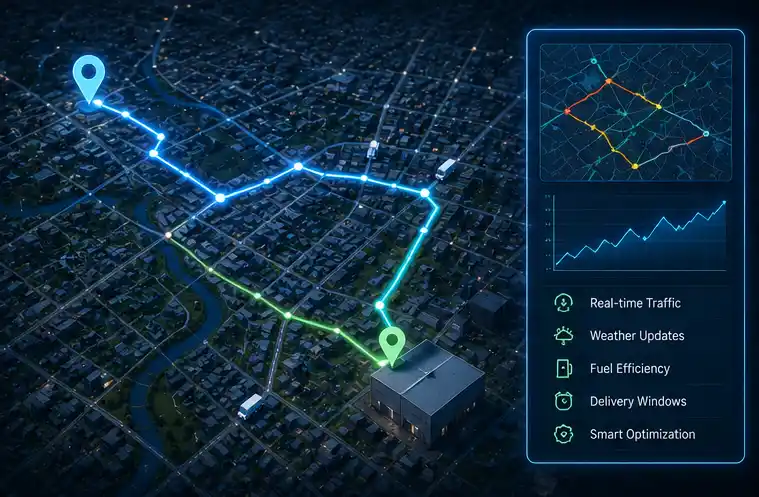
Routing involves trade-offs. Minimizing distance, meeting delivery windows, balancing work between vehicles, and accommodating capacity limits can lead to different plans. A mathematically good answer depends on which objective and constraints the planner actually includes.
As an illustrative example, imagine a van visiting a nearby address first because it reduces distance, while a later stop has an earlier closing time. The plan can be short and still fail. Similarly, a road route suitable for a car may be unsuitable for a particular loaded vehicle.
The image is a conceptual route-planning view, not a verified live route. Dispatchers and drivers need current access information and a safe way to report exceptions. A suggested route is not authorization to ignore signs, vehicle restrictions, safe working practices, or required breaks.
Warehouse Coordination: An Example from Amazon's DeepFleet
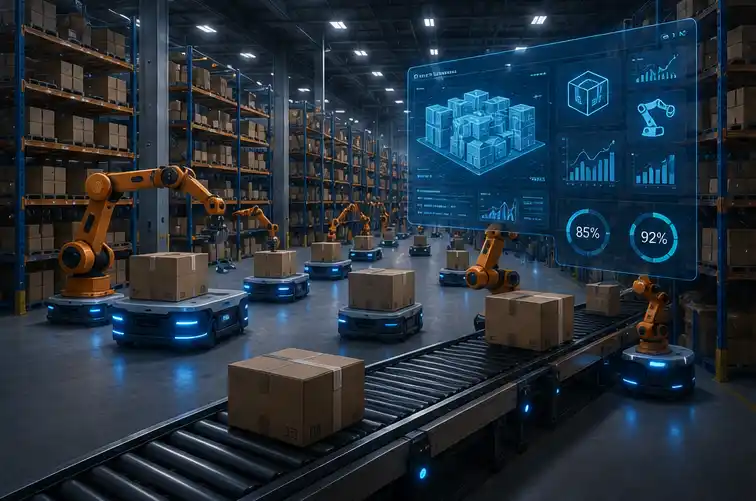
Amazon Science's August 2025 account of DeepFleet describes models trained on robot-movement data to predict interactions and congestion in fulfillment and sortation centers. The surrounding system can use predictions to inform coordination. This is a different problem from controlling a delivery van on public roads.
Amazon reported a 10% efficiency improvement in its robot deployments. That is a provider-reported result in its own operating context, not independent evidence that every warehouse gains 10%, that customer deliveries become 10% faster, or that safety improves by the same amount.
The illustration shows a possible automated warehouse, not Amazon's actual installation. Better movement coordination can help one part of fulfillment while another station remains the bottleneck. Evaluation should include the whole flow, worker interaction, exceptions, and recovery when equipment stops—not only robot travel speed.
Fleet Signals and Demand Forecasts Need Context
Possible fleet applications include identifying unusual equipment readings, estimating available capacity, or forecasting order volumes for a depot. Their value depends on the data available and whether a team has a useful response. Collecting vehicle locations or issuing a fixed service reminder does not itself establish that a system uses AI.
An illustrative demand model may predict a busy afternoon from past orders but miss an unexpected event. A maintenance model may flag an unusual reading without identifying its cause. Neither prediction should be treated as certainty or as a reason to bypass established servicing and safety procedures.
Our practical recommendation is to compare against a sensible baseline and include the cost of responding to errors. Extra inventory, spare capacity, false alarms, and missed warnings all affect the result. A model with a lower average prediction error is not automatically the best operational choice.
Autonomous Delivery Has Operating Boundaries
Route recommendations, driver assistance, and automated driving are different capabilities. NHTSA's explanation of Level 2 assistance says the driver remains engaged and responsible for monitoring. Its Level 4 description instead concerns a system performing the driving task within limited service areas, not everywhere. The responsibilities depend on the actual system and its permitted conditions.
Drone delivery also requires more than an aircraft capable of carrying a box. The U.S. FAA's package-delivery guidance describes operator certification, airspace authorization, and other approvals and limitations. Beyond visual line of sight, or BVLOS, means operation outside the pilot's direct view; an AI feature does not itself authorize it.
These are U.S. examples, not worldwide rules or a complete compliance guide. Weather, payload, access, operating area, and exception handling need attention for the specific service. A successful demonstration on one route is not evidence that a service can safely deliver any parcel to any address.
Last-Mile Exceptions Are Part of the Product
A route plan encounters reality at the handover: a missing entrance code, an inaccessible drop-off point, an incorrect address, or a recipient who is unavailable. These examples show why the exception process matters as much as the normal journey.
A useful system should distinguish predicted, attempted, and confirmed events. An estimated arrival is not a completed delivery, and a generated support message is not proof that a redelivery request has been recorded. Customers and staff need an official status record and a route to resolve discrepancies.
Our assessment is that improving a delivery service includes making uncertainty understandable. Tracking should help explain what is known, when it was updated, and what action is available, without presenting a prediction as a guarantee.
Data, Permissions, and the Full Cost of a Pilot
Delivery data can include addresses, location histories, access instructions, and information about staff activity. Decide which information a service needs, who can access it, how long it is retained, and what happens when a supplier or connection is unavailable. Do not send confidential records to an unapproved assistant simply because it can produce a route or summary.
NIST's voluntary AI Risk Management Framework provides a general way to organize governance and the mapping, measurement, and management of AI risks. It is not a transport safety approval. For a deployment, the practical questions include what the system can read or change, who reviews problems, and what fallback remains available.
Our suggested pilot checklist below separates a measurable service improvement from an appealing demonstration. Faster delivery, lower cost, fewer emissions, and better working conditions are distinct outcomes; one should not be claimed simply because another improved.
- Choose one problem and baseline: for example, inaccurate arrival windows or repeated missed delivery slots.
- Test representative routes, locations, parcel types, and operating conditions rather than only easy cases.
- Track on-time completion and failed attempts alongside distance, cost, staff effort, and error handling.
- Check who can override a recommendation and how drivers, warehouse staff, and customers report exceptions.
- Include integration, support, data quality, downtime, and recovery costs before expanding the deployment.
Frequently Asked Questions
Conclusion
AI can support better-informed delivery decisions through estimates, pattern recognition, and coordination. Its contribution is specific: predicting a road journey, anticipating warehouse congestion, or helping identify an exception. None of those alone makes an entire logistics network autonomous or guarantees a better service.
Our assessment is to judge improvements across the whole delivery journey. Reliable information, workable constraints, clear human responsibilities, safe operating boundaries, and effective exception handling are stronger foundations than promises that every parcel will arrive faster through AI.
Reviewed against primary sources
References and further reading
These research reports and official guidance provide the evidence and practical recommendations used to review this article.
- ETA Prediction with Graph Neural Networks in Google MapsDerrow-Pinion and colleagues, Google Maps / DeepMind research paper (2021)
- Vehicle Routing ProblemGoogle OR-Tools documentation
- Amazon builds first foundation model for multirobot coordinationAmazon Science (provider account, August 2025)
- Automated Vehicle SafetyU.S. National Highway Traffic Safety Administration
- Package Delivery by Drone (Part 135)U.S. Federal Aviation Administration
- AI Risk Management FrameworkNational Institute of Standards and Technology
Knowledge Hub
Learn the fundamentals first
Plain-language explainers to help you understand the concepts behind this article.
Share this article
Keep reading
Related Articles
More stories on similar topics from the NVR Nexus blog.

How AI Is Changing Media and Journalism
Artificial intelligence is changing how newsrooms research stories, analyze evidence, create formats, reach audiences, and verify digital media. The opportunity is significant—but so are the risks to accuracy, transparency, trust, and editorial independence.
How AI Is Changing the Legal Industry
Artificial Intelligence is transforming the legal industry through contract analysis, legal research, document automation, compliance monitoring, and predictive case insights. Discover how AI is reshaping the future of legal services.

How AI Is Changing Sports
Artificial Intelligence is transforming sports through performance analytics, injury prevention, intelligent coaching, AI referees, fan engagement, and data-driven decision making. Discover how AI is reshaping the future of sports.