How AI Is Changing Healthcare
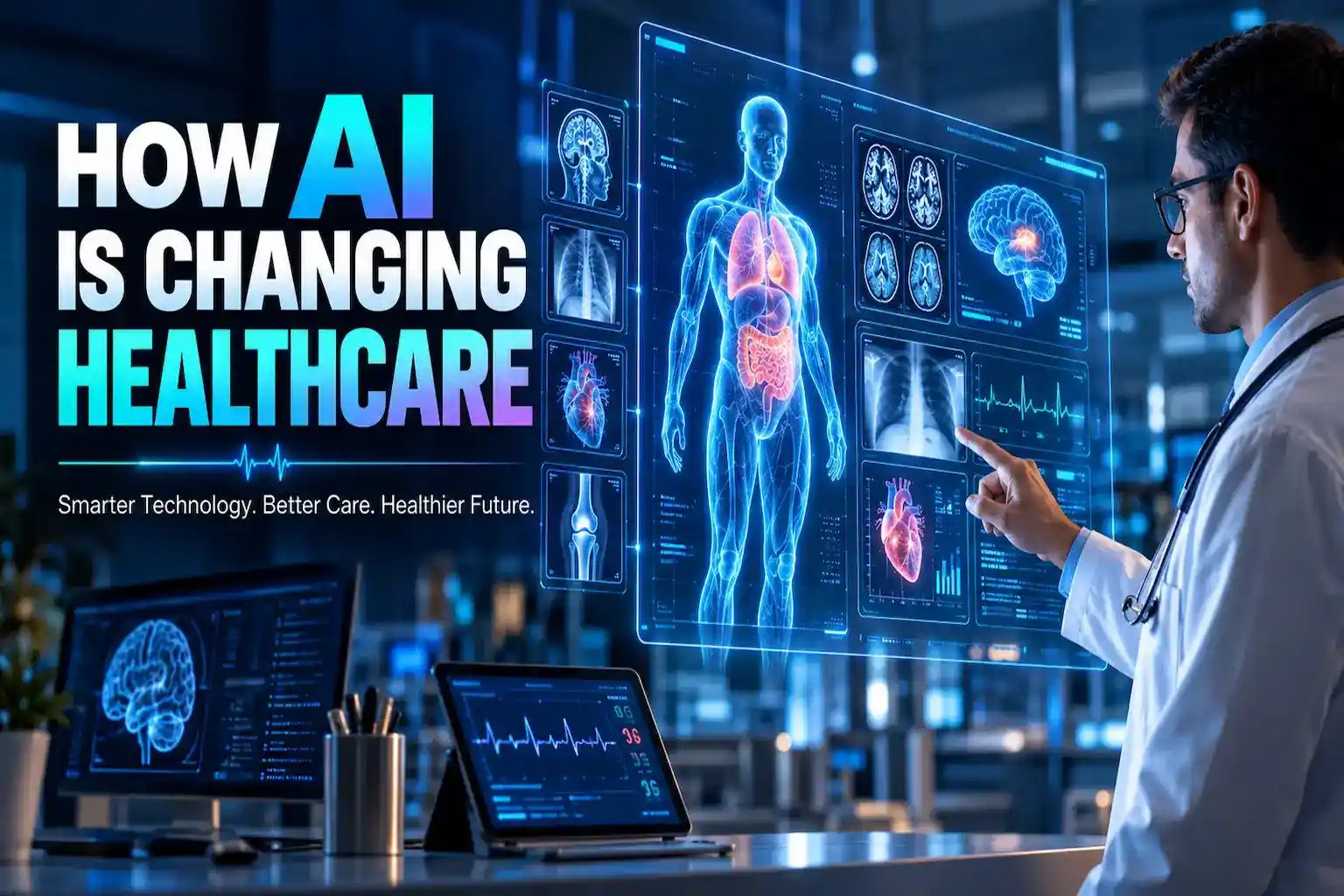
AI can help analyze scans, draft clinical notes, and support medical research. Explore what these systems actually do, what the evidence can tell us, and why privacy, testing, and clinical accountability matter.
Listen to this article
How AI Is Changing Healthcare
12 parts · Tap play to start
Uses a natural English voice available through your browser or device. Article text is not uploaded to NVR Nexus.
Introduction
AI in healthcare is not one technology doing one job. Software that flags an image for review, a tool that drafts a consultation note, and a model used in laboratory research solve different problems. Their evidence, risks, and responsibilities need to be considered separately.
The useful question is not whether AI can replace a doctor. It is whether a particular system improves a particular task for the people and setting in which it will be used. A convincing demonstration or an impressive test score is not enough to answer that question.
This article explains the technology and how to assess claims about it. It is general educational information, not medical advice, diagnosis, or treatment guidance. Decisions about symptoms, tests, medicines, and treatment belong with qualified healthcare professionals.
Clinical AI, Generative AI, and Automation Are Different
A predictive model estimates a label or score from data. An imaging system might highlight a suspected abnormality; a risk model might estimate the likelihood of a defined event. Generative AI instead produces material such as text, including a draft summary of a consultation. A service may combine both approaches.
Ordinary automation also remains important. Sending an appointment reminder at a fixed time does not require a learned model. Calling every hospital software feature AI makes it harder to understand what has changed and what needs testing.
A practical way to understand any product is to identify its input, output, and next action. Does it receive a scan, a conversation, or a patient record? Does it return a flag, a draft, or a recommendation? Who checks the result before it affects care?
Medical Imaging: Assistance for a Defined Task
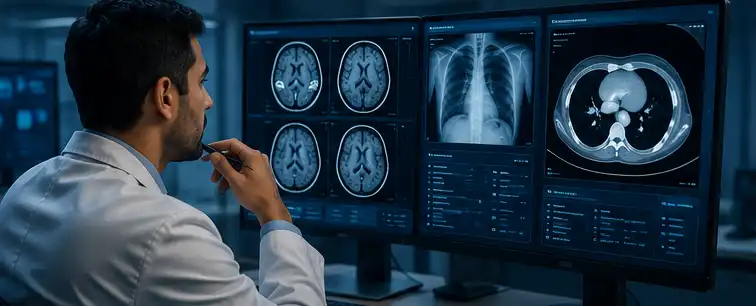
AI-enabled imaging tools can support tasks such as image analysis and identifying patterns relevant to diagnosis. Their roles differ: prioritizing a worklist, measuring a feature, and suggesting a finding are not interchangeable. The intended use determines what an output means and how it should be handled.
The U.S. FDA maintains information about AI-enabled medical devices authorized for marketing. That is evidence about specific devices and uses, not an endorsement of every medical chatbot or every possible use of a model. Requirements in other countries may differ.
A useful question for a scan-analysis claim is: what exactly was tested? Finding a feature in selected images is different from proving that using the tool improves care in a busy clinic. Faster processing, diagnostic performance, and patient outcomes are separate measures.
Clinical Notes: A Useful Draft Still Needs Review
An ambient AI scribe processes a consultation recording or transcript to draft a clinical note. The promise is less manual documentation. The safety question is whether the draft preserves what was actually said, including uncertainty, medicines, and the agreed plan.
A 2025 study in Frontiers in Artificial Intelligence compared AI-generated and physician-drafted notes based on 97 recorded encounters across five specialties. AI notes were rated more thorough and organized, but physician notes scored better overall; reviewers identified hallucinations in both groups, more often in the AI notes.
This was a study of a particular system and evaluation setup, with vendor-affiliated authors. It does not establish an error rate for every scribe or show that all errors reached patients. It illustrates why fluent documentation needs checking rather than automatic acceptance.
Drug Discovery: A Prediction Is Not a Proven Medicine

AI can support scientific research and the search for potential drug compounds. It can help narrow a research question or prioritize possibilities to investigate. A promising computational result is a starting point for experiments, not evidence that a treatment is safe or effective in people.
NIH's drug-development overview describes a process spanning discovery, nonclinical development, clinical investigations, and regulatory oversight. Questions about toxicity, exposure, benefits, and adverse effects remain even when an algorithm helped select a candidate.
When reading an AI drug-discovery headline, look for the actual milestone: a prediction, a laboratory result, a trial starting, a completed trial, or a marketing authorization. These describe very different levels of evidence. Avoid interpreting a research announcement as an available treatment.
Monitoring and Treatment Support Need Clear Boundaries
Some AI-enabled medical devices support diagnosis or treatment, while others analyze measurements or provide information for review. The FDA emphasizes intended use and management across a device's lifecycle. A system's permissions and instructions matter more than the AI label on its packaging.
For any monitoring feature, ask what it measures, what an alert means, and who is expected to respond. A consumer wellness feature and a regulated medical function should not be treated as equivalent. Neither the absence of an alert nor a reassuring chatbot response should be used to dismiss a health concern.
Why Good Test Results May Not Transfer to Every Hospital
Data used to develop a model may not represent everyone who later encounters it. Equipment, image acquisition, patient populations, and clinical workflows can differ. Evaluation needs to examine those differences rather than relying only on one overall accuracy figure.
An NIH NIBIB report on medical-imaging research describes how models can use demographic signals and how fairness may change across deployment settings. Removing an explicit demographic field does not necessarily remove related information from the input or prevent unequal performance.
Our practical reading checklist is to ask about independent testing, performance across relevant groups, false positives, false negatives, and what happens after an error. A missed finding and an unnecessary alarm have different consequences; a single headline score can hide both.
Privacy and Accountability Are Part of the Design
WHO's guidance on AI for health places ethics and human rights at the center of design, deployment, and use. Its separate guidance on large multimodal models warns about inaccurate or biased output, cybersecurity risks, and automation bias: accepting a system's suggestion too readily.
Before using a service with sensitive records or consultation audio, ask who receives the information, why it is needed, how long it is retained, and whether it is used for model training. An institution's approved clinical system and a public chatbot may have very different arrangements.
Meaningful oversight also needs an owner: someone who can review an output, correct a record, investigate a problem, or stop unsafe use. Adding a person at the end of a workflow is not enough if that person lacks time, context, or authority to challenge the result.
Questions Patients Can Ask About Healthcare AI
You do not need to understand a model's mathematics to ask how it affects your care. The following questions are a practical conversation guide, not a certification checklist or a guarantee that a service is safe.
- What task is the tool doing, and what decisions remain with my care team?
- Has it been evaluated for patients and conditions like mine?
- If a consultation is recorded, what choices do I have and how is the recording handled?
- Who reviews generated notes or recommendations before they enter my record or care plan?
- How can I report a mistake, ask for clarification, or request a correction?
Frequently Asked Questions
Conclusion
The strongest way to assess healthcare AI is task by task: identify the intended use, inspect the evidence, understand the failure modes, and establish who is accountable. Improvements in documentation or image analysis can be useful without supporting sweeping claims about replacing clinicians or transforming every patient outcome.
Our assessment is that progress should be judged by demonstrated benefits in actual care settings, not by how human an interface sounds. Clear limits, patient participation, and a workable route to correction are as important as the model itself.
Reviewed against primary sources
References and further reading
These research reports and official guidance provide the evidence and practical recommendations used to review this article.
- Artificial Intelligence-Enabled Medical DevicesU.S. Food and Drug Administration
- Implementing medical imaging AI: issues to considerNIH National Institute of Biomedical Imaging and Bioengineering
- Assessing the quality of AI-generated clinical notes: validated evaluation of a large language model ambient scribeFrontiers in Artificial Intelligence (2025)
- Drug DevelopmentNational Institutes of Health Clinical Center
- Ethics and governance of artificial intelligence for healthWorld Health Organization (2021)
- WHO releases AI ethics and governance guidance for large multi-modal modelsWorld Health Organization (2024)
Knowledge Hub
Learn the fundamentals first
Plain-language explainers to help you understand the concepts behind this article.
Share this article
Keep reading
Related Articles
More stories on similar topics from the NVR Nexus blog.
How AI Is Changing Media and Journalism
Artificial intelligence is changing how newsrooms research stories, analyze evidence, create formats, reach audiences, and verify digital media. The opportunity is significant—but so are the risks to accuracy, transparency, trust, and editorial independence.
How AI Is Changing the Legal Industry
Artificial Intelligence is transforming the legal industry through contract analysis, legal research, document automation, compliance monitoring, and predictive case insights. Discover how AI is reshaping the future of legal services.
How AI Is Changing Sports
Artificial Intelligence is transforming sports through performance analytics, injury prevention, intelligent coaching, AI referees, fan engagement, and data-driven decision making. Discover how AI is reshaping the future of sports.