How AI Is Transforming Education
AI can draft teaching materials, offer practice feedback, and support language learning. Discover what classroom research shows, why getting an answer is different from learning, and how schools can use these tools responsibly.
Listen to this article
How AI Is Transforming Education
12 parts · Tap play to start
Uses a natural English voice available through your browser or device. Article text is not uploaded to NVR Nexus.
Introduction
AI is entering education through several different doors: a teacher drafts practice questions, a student asks for a hint, and a learning platform recommends the next exercise. These activities can look similar on a screen while having very different effects on teaching and learning.
The important distinction is between producing work and developing understanding. A tool can help someone finish a worksheet without helping them solve a similar problem independently. It can also save preparation time without proving that students learned more.
This article focuses on practical classroom uses and what the evidence can establish. Benefits depend on the task, the design of the tool, the learner, and the surrounding teaching. They are not guaranteed by adding an AI feature to a course.
Adaptive Learning Is Not the Same as a Chatbot
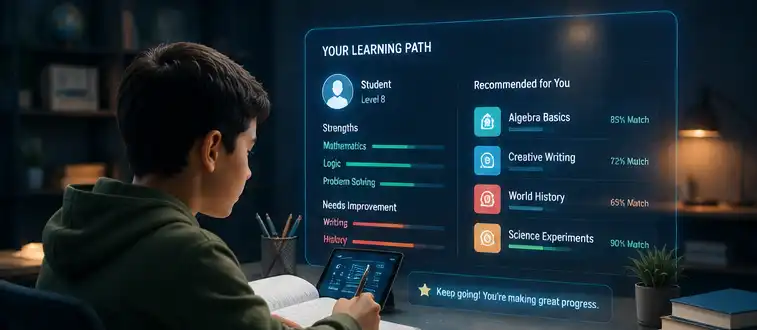
An adaptive platform can select exercises using previous answers, estimated mastery, or other signals. A generative chatbot produces responses to prompts. A service may combine these methods, but a conversation alone does not establish that it has accurately diagnosed a student's needs.
For example, a learner repeatedly missing fraction questions might need help with equivalent fractions, reading the question, or a prerequisite skill. Recommending more of the same exercise is not necessarily the right response. A teacher can investigate the reason behind the pattern.
The illustration shows a conceptual learning dashboard, not evidence about a real product. Labels such as 'personalized' or 'recommended' should invite questions about what was measured, how a recommendation was chosen, and whether it actually helped.
AI Tutors: Better Practice Scores Are Not Always Better Learning
An AI tutor can offer explanations, hints, and practice questions. Its educational value depends partly on whether the student still does the reasoning. A complete solution can remove the very step the exercise was intended to teach.
A 2025 PNAS paper reports a randomized study involving nearly 1,000 students at one high school in Turkey. Both a general GPT-4 interface and a teacher-informed tutoring interface improved performance during assisted mathematics practice. On the later unassisted exam, the general-interface group performed worse than the group without AI access.
The tutoring guardrails largely removed that negative effect, but did not establish an unassisted-exam advantage over the control group. This was a specific, short-term mathematics setting using particular systems, not a verdict on every AI tutor, subject, or age group. It shows why evaluations should test learning after assistance is removed.
Teacher Preparation: A Measurable Benefit with a Defined Scope
Teachers can use generative tools to draft question variations, suggest examples, or adapt the wording of materials. The output still needs checking for curriculum fit, factual accuracy, appropriate difficulty, and misleading answer keys.
NFER's 2024 Teacher Choices trial involved 259 Year 7 and Year 8 science teachers from 68 schools in England. During the measured weeks, the ChatGPT group spent about 56 minutes per week on the relevant lesson and resource preparation, compared with about 82 minutes in the non-GenAI group: roughly 31% less time.
Participants received guidance, and the trial included a familiarization period. The result concerns preparation for those science lessons, not a 31% reduction in teachers' total working hours or proof of higher student attainment. It is a useful example of measuring a bounded task rather than promising a universal transformation.
Language Practice and Accessibility: Support, Not a Universal Fix
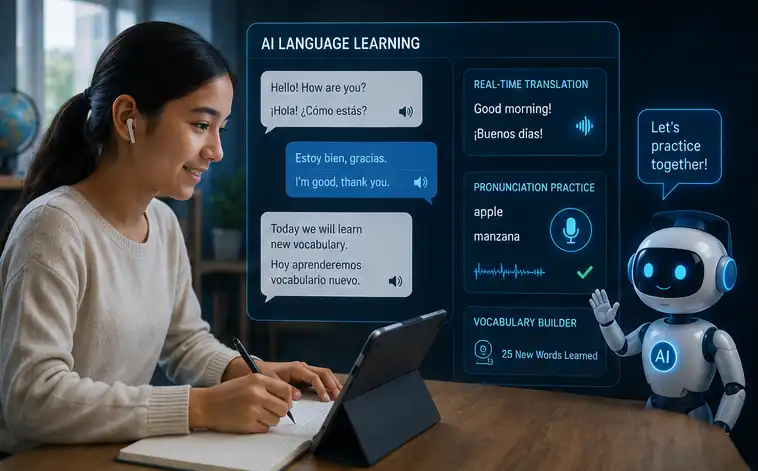
Possible uses include rehearsing a conversation, generating vocabulary exercises, rephrasing a passage, or providing draft translations and captions. The right question is whether the feature removes a real barrier for the learner, not whether it sounds impressive in a demonstration.
As an illustrative activity, a student could write a short response in a language they are studying, request an explanation of two possible corrections, then discuss the difference with a teacher. The explanation itself still needs checking; fluent wording can hide an incorrect rule or an unsuitable register.
UNESCO's guidance emphasizes human agency, inclusion, equity, and linguistic and cultural diversity. Device access, connectivity, supported languages, accessible interfaces, and the option to learn without a particular service all affect who benefits. Translation or simplified wording should not be assumed to meet every accessibility need.
Feedback, Grading, and Academic Integrity Need Different Rules
Practice feedback helps a learner revise; a formal grade affects an educational decision. A draft comment on an argument is not the same as a reliable judgment of originality, subject knowledge, or performance against a rubric. Schools need to define which roles a tool may play and who reviews the outcome.
The UK's Joint Council for Qualifications explains that assessment policies should make permitted AI use, acknowledgment requirements, and misuse clear. Those rules apply within its qualifications context; learners elsewhere should check their own institution and assignment instructions rather than assume a worldwide policy.
JCQ also says detection tools should be part of a holistic review of authenticity. A detector output is not a substitute for considering drafts, sources, the student's explanation, and other available evidence. Our recommendation is to make expectations explicit before work begins and give students a fair route to clarify concerns.
Privacy, Age Suitability, and Human Responsibility
The UK Department for Education's guidance recommends avoiding personal data in generative AI tools and emphasizes professional responsibility for the final material. Its policy is specific to its education context, but the practical questions about data handling matter wherever a school evaluates a service.
Ask whether prompts or uploaded files are retained, who can access them, whether they are used for training, and what deletion controls exist. Student names, assessment records, disability information, and private conversations should not be casually copied into an unapproved tool.
UNESCO calls for age-appropriate safeguards and institutional evaluation of educational suitability. There is no single age rule that can be assumed for every service and jurisdiction. Check the current product terms, school policy, and applicable requirements; adult supervision alone does not make every platform suitable for children.
A Practical Study Session That Keeps the Thinking with the Learner
The following is an example of a bounded practice activity, not a guaranteed method for improving grades. Use it only where the course permits AI assistance, and use teacher-approved material as the reference.
- Choose one objective: for example, explain why two fractions are equivalent.
- Attempt a question yourself and write down the step that is unclear.
- Ask for one hint or a question about that step, not a complete worked answer.
- Check the hint against your textbook or teacher's explanation, then finish the problem yourself.
- Close the assistant and solve a fresh problem without help. Record what you still cannot explain.
How a School Can Evaluate a Small AI Pilot
Our suggested starting point is one use case with a clear purpose, an approved data arrangement, and an alternative for people who cannot use the tool. Keep the pilot small enough to inspect mistakes and change course.
Separate the measures: teacher time saved, correction time added, the quality of materials, and students' independent understanding answer different questions. Collect feedback from the people using the system and those affected by it. Decide in advance what would count as a reason to stop, revise, or continue.
This is a practical evaluation framework, not a replacement for a school's safeguarding, accessibility, procurement, or assessment procedures. A successful trial in one class should inform the next test rather than become a promise for every learner.
Frequently Asked Questions
Conclusion
AI's educational value is not measured by the number of answers it generates. It is measured by whether it supports useful teaching, preserves students' opportunities to think, and produces benefits that hold up when the assistance is no longer available.
Our assessment is that carefully scoped uses deserve more attention than sweeping promises. Teacher-reviewed materials, independent practice, clear assessment rules, and appropriate data safeguards provide a more credible path than assuming every classroom needs an always-on AI tutor.
Reviewed against primary sources
References and further reading
These research reports and official guidance provide the evidence and practical recommendations used to review this article.
- Guidance for generative AI in education and researchUNESCO
- Generative AI without guardrails can harm learning: Evidence from high school mathematicsProceedings of the National Academy of Sciences (2025)
- ChatGPT in lesson preparation – A Teacher Choices TrialNational Foundation for Educational Research (2024)
- Generative artificial intelligence (AI) in educationUK Department for Education
- AI Use in Assessments: Your role in protecting the integrity of qualificationsJoint Council for Qualifications
Knowledge Hub
Learn the fundamentals first
Plain-language explainers to help you understand the concepts behind this article.
Share this article
Keep reading
Related Articles
More stories on similar topics from the NVR Nexus blog.

How AI Is Changing Media and Journalism
Artificial intelligence is changing how newsrooms research stories, analyze evidence, create formats, reach audiences, and verify digital media. The opportunity is significant—but so are the risks to accuracy, transparency, trust, and editorial independence.
How AI Is Changing the Legal Industry
Artificial Intelligence is transforming the legal industry through contract analysis, legal research, document automation, compliance monitoring, and predictive case insights. Discover how AI is reshaping the future of legal services.
How AI Is Changing Sports
Artificial Intelligence is transforming sports through performance analytics, injury prevention, intelligent coaching, AI referees, fan engagement, and data-driven decision making. Discover how AI is reshaping the future of sports.