How AI Is Changing Finance and Banking
From transaction risk scores to banking assistants and credit analysis, AI supports specific financial tasks. Explore how these systems work, what adoption data shows, and where fairness, privacy, and accountability matter.
Listen to this article
How AI Is Changing Finance and Banking
12 parts · Tap play to start
Uses a natural English voice available through your browser or device. Article text is not uploaded to NVR Nexus.
Introduction
AI in banking can mean a transaction risk score, a draft response to a customer, or software that extracts information from a document. These systems perform different tasks. Their speed, accuracy, permissions, and consequences need to be evaluated separately.
The useful question is not whether a bank uses AI, but what the system does and what happens when it is wrong. A tool that helps an employee find a policy has different risks from one that influences a credit decision or initiates a payment.
This article explains the technology and the evidence behind selected uses. It is general educational information, not personalized financial, investment, tax, or legal advice. Product terms, consumer protections, and regulatory requirements vary by service and jurisdiction.
What the Adoption Data Actually Shows
The Bank of England and Financial Conduct Authority's 2024 survey received responses from 118 financial firms. Of those respondents, 75% reported using AI, and another 10% planned to use it over the following three years. These are dated findings from a particular UK financial-services sample, not a current global banking adoption rate.
The survey also found that only 2% of reported AI use cases involved fully autonomous decision-making. Using AI therefore does not necessarily mean handing over an entire process. Many deployments support analysis, internal operations, or decisions that retain human oversight.
Adoption is also different from demonstrated benefit. A survey can show what firms report using without proving that every system reduces fraud, saves customers money, or treats applicants fairly. Those outcomes need their own measurements.
Fraud Detection: A Risk Signal, Not a Guarantee

Payment monitoring can combine rules, behavioral analysis, and learned models. Visa describes systems that assess transaction patterns and generate predictive risk scores. A score can inform a decision to allow a transaction, request another check, block it, or send it for investigation.
For example, an unusual payment from an unfamiliar device might trigger additional verification. That does not prove the payment is fraudulent: a legitimate customer may be traveling or making an uncommon purchase. Equally, a transaction that passes screening is not guaranteed to be safe.
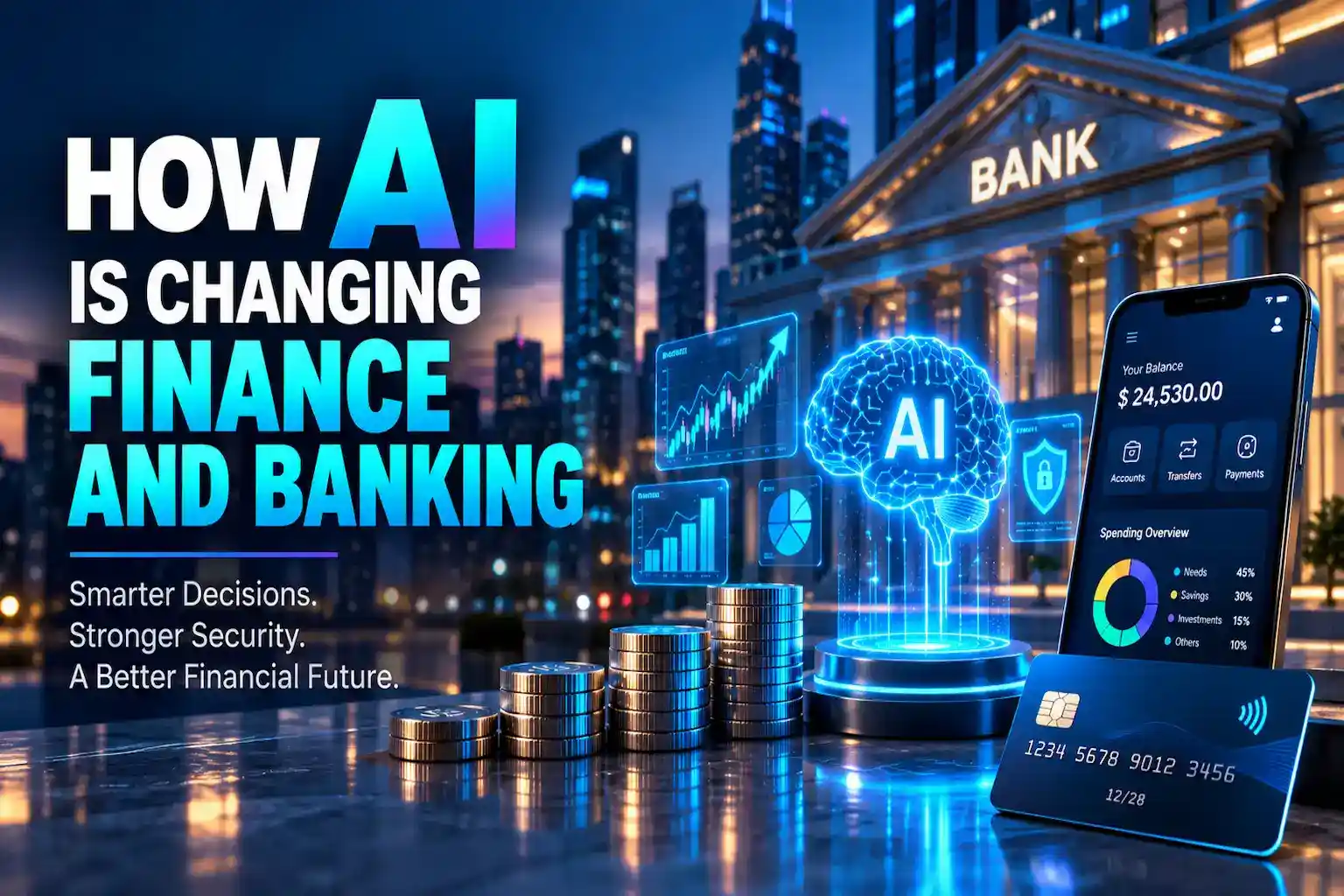
The illustration is a conceptual monitoring screen, not a real bank interface or evidence that every threat is stopped. Models do not necessarily learn from each new transaction immediately; retraining, validation, and deployment updates are separate processes. A monitoring team must manage both missed fraud and unnecessary interruptions.
Customer Support: A Reply Is Not a Completed Action
Some banking assistants follow decision trees, some retrieve approved information, and others generate replies. Their ability to check an account, change a setting, or register a request depends on the systems and permissions connected to them. A convincing conversational interface does not establish that those actions occurred.
The U.S. Consumer Financial Protection Bureau's 2023 report on financial chatbots documents concerns about inaccurate responses, difficulties resolving complex problems, and barriers to timely human support. These findings describe risks and reported experiences, not a failure rate for every banking assistant.
As a practical check, distinguish an explanation from a transaction record. A chatbot saying that it can help with a dispute is not the same as a case reference confirming that the dispute was filed. For an unresolved or time-sensitive issue, use the bank's official support channels and retain relevant confirmations.
Lending and Credit Scoring: Speed Does Not Establish Fairness
AI can support analysis of credit information and estimates of repayment risk. That does not make the output objective or complete. The Bank for International Settlements discusses how biased or inaccurate training data can contribute to discrimination and disparities in access to credit.
An applicant with limited recorded history presents a different problem from an applicant with extensive reliable records. More variables are not automatically better if they are inaccurate, irrelevant, or encode unwanted proxies. Evaluation should consider performance across relevant groups as well as an overall predictive score.
Our practical test for a lending claim is to ask what information is used, what the system predicts, how its output influences the decision, and how errors can be reviewed. A model's estimated risk is not the same as a verified fact about a person's future. Applicable explanation, review, and discrimination requirements depend on the jurisdiction and product.
Investment Research: Analysis Is Not a Promise of Returns
Possible research tasks include organizing disclosures, comparing reported figures, or drafting a summary for an analyst to check. Those tasks are different from choosing a suitable investment or placing a trade. An automated service may also use conventional rules; the label 'robo-adviser' does not by itself reveal its technology.
An illustrative example is a generated company summary that combines an old annual report with a recent announcement. Even if each source exists, the comparison may mix reporting periods, currencies, or assumptions. The analyst still needs to reconcile the original documents before relying on the conclusion.
Investor.gov's joint SEC, NASAA, and FINRA alert warns about schemes claiming that AI can deliver guaranteed investment winners or high returns with little risk. An AI label, a polished dashboard, or a simulated result is not evidence that a strategy will perform as claimed.
Document Processing and Internal Workflows
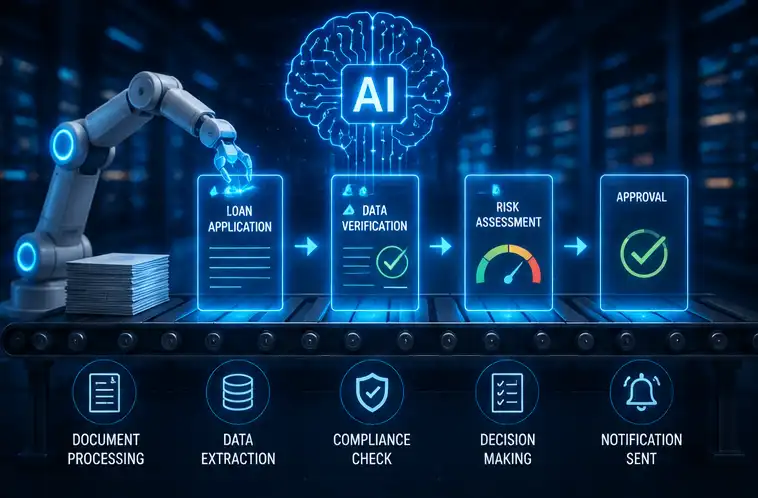
A document workflow might extract fields, compare records, flag missing information, and prepare a case for review. The conceptual illustration shows a possible sequence, not a promise of automatic loan approval. Digitizing a process and introducing AI are not the same thing.
Consider an illustrative extraction task: software reads a figure as 80,000 when the source says 30,000. If later checks accept the extracted value without inspecting the source, a small recognition error can affect several downstream steps. Useful controls include retaining the source, validating important fields, and routing uncertainty to a reviewer.
Our suggested evaluation is to measure the complete workflow: processing time, correction work, missed errors, and the effect on customers. Faster extraction alone does not establish that the overall process is more accurate or that compliance obligations have been satisfied.
Questions to Ask Before Trusting a Financial AI Claim
The following is a practical reading checklist, not a certification of a product or provider. Its purpose is to separate a technology claim from evidence about an actual financial service.
- What exact task is automated, and can the system act on an account or only provide information?
- What evidence supports the claimed improvement, and does it measure customer outcomes as well as speed?
- Which data, dates, assumptions, and limitations affect the output?
- Who can review an error, correct a record, or take over an unresolved request?
- Is the provider verifiable through official channels, and are the costs, risks, and terms clear?
Frequently Asked Questions
Conclusion
AI can contribute to financial services through specific analytical, conversational, and operational tasks. Its value needs to be demonstrated in the setting where it is used, with attention to mistakes, costs, fairness, privacy, and the ability to resolve problems.
Our assessment is that accountable systems matter more than autonomous-sounding marketing. A clear purpose, evidence of benefit, controlled permissions, and a workable route to human review provide a stronger basis for trust than claims that banking has simply become smarter or safer.
Reviewed against primary sources
References and further reading
These research reports and official guidance provide the evidence and practical recommendations used to review this article.
- Artificial intelligence in UK financial services – 2024Bank of England and Financial Conduct Authority
- Smarter transaction monitoring for secure paymentsVisa (provider explanation)
- Chatbots in consumer financeU.S. Consumer Financial Protection Bureau (2023)
- Artificial intelligence and the economy: implications for central banksBank for International Settlements (2024)
- Artificial Intelligence (AI) and Investment Fraud: Investor AlertSEC Office of Investor Education and Advocacy, NASAA, and FINRA (2024)
- Monitoring Adoption of Artificial Intelligence and Related Vulnerabilities in the Financial SectorFinancial Stability Board (2025)
Knowledge Hub
Learn the fundamentals first
Plain-language explainers to help you understand the concepts behind this article.
Share this article
Keep reading
Related Articles
More stories on similar topics from the NVR Nexus blog.

How AI Is Changing Media and Journalism
Artificial intelligence is changing how newsrooms research stories, analyze evidence, create formats, reach audiences, and verify digital media. The opportunity is significant—but so are the risks to accuracy, transparency, trust, and editorial independence.
How AI Is Changing the Legal Industry
Artificial Intelligence is transforming the legal industry through contract analysis, legal research, document automation, compliance monitoring, and predictive case insights. Discover how AI is reshaping the future of legal services.
How AI Is Changing Sports
Artificial Intelligence is transforming sports through performance analytics, injury prevention, intelligent coaching, AI referees, fan engagement, and data-driven decision making. Discover how AI is reshaping the future of sports.