How AI Is Changing Agriculture
AI can help turn field images and sensor readings into information for crop management. Explore monitoring, irrigation research, targeted weed control, and the practical limits that determine whether a tool works on a farm.
Listen to this article
How AI Is Changing Agriculture
12 parts · Tap play to start
Uses a natural English voice available through your browser or device. Article text is not uploaded to NVR Nexus.
Introduction
AI in agriculture can mean software that recognizes weeds in images, estimates crop water stress, or helps interpret field observations. It does not mean one system understands everything happening on a farm. Each application has a particular input, a defined task, and conditions in which it may fail.
A useful question is whether a tool improves a specific decision or operation under local conditions. A successful demonstration is different from reliable performance through changing weather, crop growth stages, and equipment problems. Faster analysis is valuable only if the information leads to an appropriate response.
This article explains the technology and selected research examples. It is not a crop diagnosis, pesticide recommendation, irrigation prescription, or machinery operating guide. Treatment and operating decisions should follow local agronomic advice, applicable requirements, product labels, and equipment instructions.
Precision Agriculture, Automation, and AI Are Different
Precision agriculture manages differences within or between fields using measurements and location-specific information. It can include positioning systems, maps, sensors, and variable-rate equipment. Not every precision tool requires AI, and a drone collecting images is not necessarily analyzing them with a learned model.
Automation executes a process with less manual intervention. AI may contribute perception or prediction within that process: a camera model recognizes a plant, while a separate controller decides when to activate a nozzle. A sensor-triggered rule and a machine-learning prediction are different approaches, even if both are marketed as smart farming.
To understand a product, trace the workflow: what is measured, what the model estimates, what action follows, and who checks it. This helps separate a useful component from a claim that an entire farm can run itself.
Crop Monitoring: Finding Where to Look More Closely
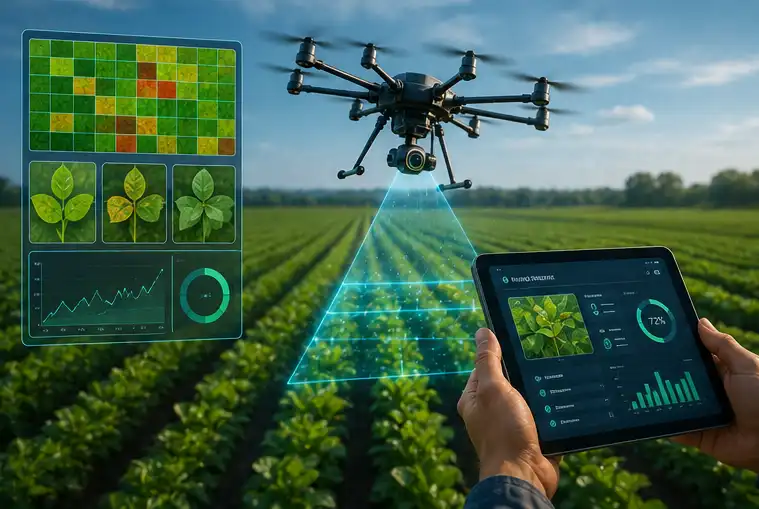
Field imagery can come from satellites, drones, cameras on machinery, or a phone. Computer vision can help classify plants, locate weeds, or map signs of stress. USDA's Digital Agricultural Systems Hub, or DASH, combines agricultural image datasets, models, and sensing technologies to support this type of work.
DASH describes tools for weed and disease mapping and research on crop characteristics. It illustrates the infrastructure behind agricultural AI: collecting representative images, labeling them, training models, and connecting the results to field equipment. An attractive dashboard alone does not provide that foundation.
The image above is a conceptual illustration, not a live product interface. A highlighted patch is a reason to investigate, not proof of a particular disease or deficiency. Ground observations and, where needed, specialist assessment remain important before deciding what to do.
Irrigation: Decision Support Rather Than Exact Answers
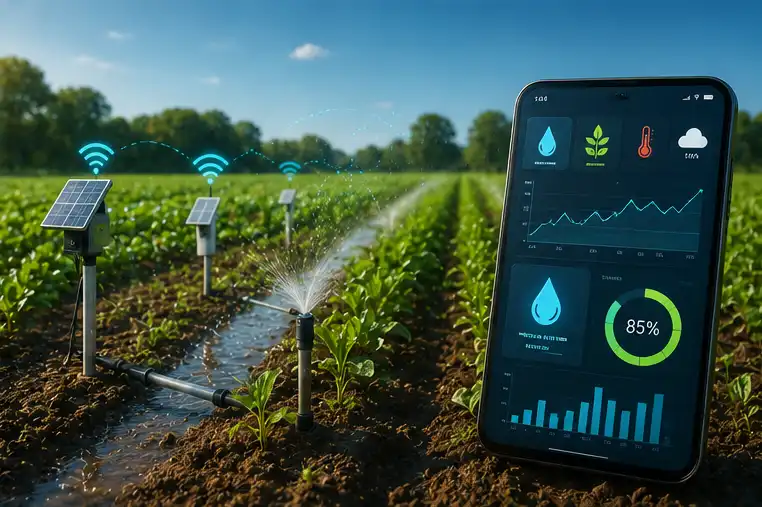
Irrigation scheduling can use soil measurements, weather information, crop conditions, and water-balance calculations. AI is one possible part of that process. A controller following a fixed moisture threshold does not become a learned system simply because it connects to an app.
USDA ARS's 2023 research report describes an artificial neural network developed with the University of Nevada, Reno to predict canopy temperature and crop water stress. Its inputs included historical canopy temperature, weather, irrigation treatment, and the last irrigation date. The work aimed to add redundancy when sensor data were missing or unavailable.
That is a defined research application, not evidence that any app can calculate an exact watering schedule for every crop. Local calibration, reliable measurements, equipment capacity, and changing conditions still matter. The illustration shows a possible monitoring setup; its displayed percentage is not an agronomic recommendation.
Weeds and Plant Symptoms: Recognition Needs a Defined Scope
A vision model may identify a target plant and help direct an operation toward it. University of Florida IFAS Extension describes an experimental precision sprayer programmed to treat a particular weed while avoiding bare ground, the crop, and other plants. That demonstrates a specific recognition-and-control task, not universal pest detection.
Performance needs checking against the actual targets and conditions. For an illustrative example, overlapping leaves or an unfamiliar growth stage could make a target harder to distinguish. Missing a weed and treating a crop by mistake have different consequences, so a single accuracy score may not describe the operational risk.
Similarly, a photo-based suggestion about a plant symptom is not a confirmed cause. Do not let a generated label become an automatic chemical recommendation. Confirm the problem and follow qualified local guidance and applicable product instructions before treatment.
Robotics: One Automated Task Is Not a Fully Autonomous Farm
Agricultural robotics brings together sensing, positioning, mechanical systems, and control software. IFAS describes machine-vision work for identifying and locating ripe strawberries for robotic harvesting. Recognizing the fruit and successfully picking it are separate challenges within a larger operation.
A machine that performs well on a defined crop and field layout should not be assumed to handle every variety, slope, obstacle, or weather condition. Evaluation should include missed work, crop damage, maintenance, stoppages, and the effort needed to supervise or recover the machine.
Our practical view is to evaluate autonomy task by task. Establish the operating boundaries, emergency procedures, support arrangements, and safe fallback before use. An AI capability is not permission to bypass machinery safety instructions or leave equipment operating outside its approved conditions.
Why a Good Model May Fail in a Different Field
A model learns from the examples and measurements used to develop it. Different camera positions, crop varieties, lighting, soil backgrounds, and growth stages can change the input. Success on a prepared image collection is therefore different from success throughout a working season.
An illustrative test is to compare performance on clear photographs with performance on the dusty, shadowed, or partly obscured views the system will actually receive. Inspect misses and false alarms, not just a vendor's best examples. Ask whether evaluation data came from fields and conditions resembling the intended use.
Predictions also need a time context. An estimate based on yesterday's observations or an earlier weather forecast may be less useful after conditions change. A credible system should help users understand data freshness, uncertainty, and when the recommendation needs review.
Costs, Connectivity, and Farm Data Can Determine Adoption
FAO's State of Food and Agriculture 2022 examined agricultural automation through 27 case studies. It identified financial constraints, digital skills, electricity, and connectivity among barriers to inclusive adoption, particularly for small-scale producers. The potential benefit of a technology is different from being able to access and maintain it.
The OECD's 2022 literature review also highlights recurring maintenance costs, relevance, usability, skills, and technological risk. It is a review from that period, not a current price comparison or proof that every type of farm benefits equally.
GAO's 2024 assessment identifies high acquisition costs, farm-data sharing and ownership concerns, and interoperability problems. Before adopting a service, ask who can access field records, whether data can be exported, what happens after cancellation, and whether existing equipment can work with it. These questions matter even when the software itself is inexpensive.
A Practical Checklist for a Small Farm Trial
Our suggested approach is to test one clearly defined problem before expanding. This is a planning framework, not a recommendation to buy a particular system or a substitute for an agronomist's trial design.
- Define the task and baseline: what decision or operation needs improvement, and how is it handled now?
- Check local fit: crop, growth stage, field conditions, language, connectivity, equipment, and available support.
- Keep an appropriate comparison and records of conditions; an unusually good season alone does not prove the technology caused a gain.
- Measure the whole result: work completed, errors, crop effects, input use, supervision, downtime, and total costs.
- Agree on review and stopping conditions, including a safe fallback when the system or connection fails.
Frequently Asked Questions
Conclusion
AI can help turn agricultural observations into useful information and support carefully defined operations. Its value depends on reliable inputs, local evaluation, practical equipment, and a sound decision process—not simply on collecting more data or adding an autonomous feature.
Our assessment is that progress should be judged field by field and task by task. Tools that farmers can understand, afford, maintain, and question offer a more credible path than promises of perfect diagnoses, guaranteed yields, or farms that no longer need human knowledge.
Reviewed against primary sources
References and further reading
These research reports and official guidance provide the evidence and practical recommendations used to review this article.
- The State of Food and Agriculture 2022: Leveraging agricultural automation for transforming agrifood systemsFood and Agriculture Organization of the United Nations
- Precision Agriculture: Benefits and Challenges for Technology Adoption and UseU.S. Government Accountability Office (2024)
- Building the Digital Infrastructure to Unlock Precision Agriculture for U.S. FarmersUSDA Agricultural Research Service
- Soil and Water Management Research: 2023 Annual Report, Project #441575USDA Agricultural Research Service
- Applications of Artificial Intelligence for Precision AgricultureUniversity of Florida IFAS Extension
- The digitalisation of agriculture: A literature review and emerging policy issuesOrganisation for Economic Co-operation and Development (2022)
Knowledge Hub
Learn the fundamentals first
Plain-language explainers to help you understand the concepts behind this article.

Share this article
Keep reading
Related Articles
More stories on similar topics from the NVR Nexus blog.

How AI Is Changing Media and Journalism
Artificial intelligence is changing how newsrooms research stories, analyze evidence, create formats, reach audiences, and verify digital media. The opportunity is significant—but so are the risks to accuracy, transparency, trust, and editorial independence.

How AI Is Changing the Legal Industry
Artificial Intelligence is transforming the legal industry through contract analysis, legal research, document automation, compliance monitoring, and predictive case insights. Discover how AI is reshaping the future of legal services.

How AI Is Changing Sports
Artificial Intelligence is transforming sports through performance analytics, injury prevention, intelligent coaching, AI referees, fan engagement, and data-driven decision making. Discover how AI is reshaping the future of sports.