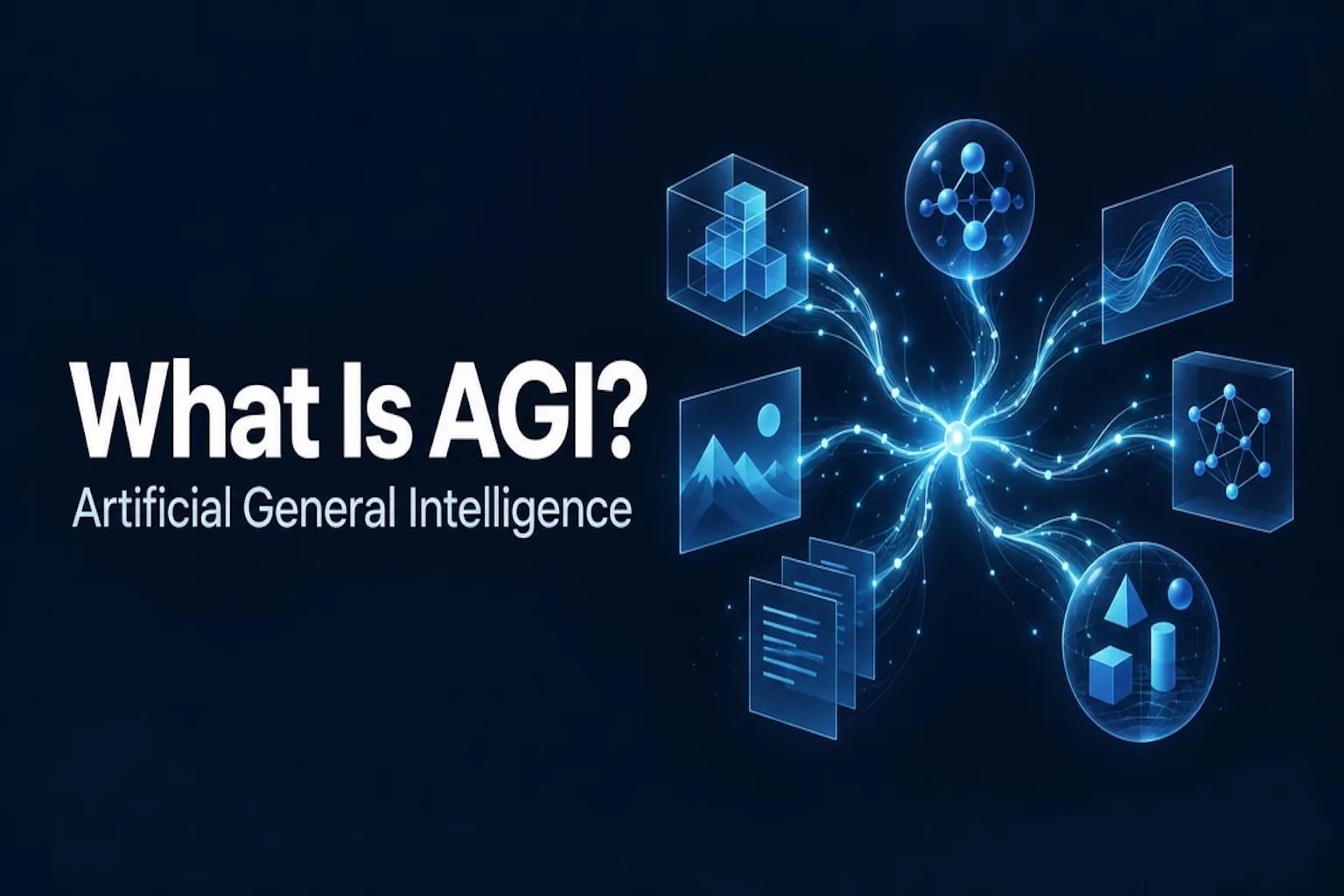
What Is AGI? Artificial General Intelligence Explained
Artificial general intelligence describes a proposed breadth of capability, not a universally agreed milestone. Learn how AGI differs from general-purpose AI, agents, consciousness, and superintelligence—and how to assess claims about progress.
Listen to this article
What Is AGI? Artificial General Intelligence Explained
12 parts · Tap play to start
Uses a natural English voice available through your browser or device. Article text is not uploaded to NVR Nexus.
What Does AGI Mean?
Artificial general intelligence, or AGI, usually describes a proposed AI system with broad capabilities comparable to or beyond human performance across a wide range of cognitive tasks. The important idea is generality: handling different kinds of problems and adapting to unfamiliar situations, rather than excelling at one carefully defined activity.
There is no single universally accepted definition or pass mark. Definitions differ over which tasks count, which people provide the comparison, how independently a system must work, and how reliably it must perform. A claim that AGI has arrived is therefore incomplete without its definition and supporting evidence.
AGI is not a synonym for perfection. Broad competence would not imply knowing every fact, solving every possible problem, or operating without limits on time, information, and resources. The term describes an ambition for capability, not a promise of an all-knowing machine.
Today's General-Purpose AI Is Broader Than a Single-Task Tool
It is misleading to describe all contemporary AI as a collection of strictly single-purpose tools. General-purpose models can work across writing, coding, image interpretation, and other activities. Some systems also retrieve information, use software tools, or perform multi-step tasks. Their breadth is real, even when their performance is inconsistent.
General-purpose AI and AGI are not interchangeable labels. A system may handle many activities while still needing substantial supervision or failing in unfamiliar settings. The 2026 International AI Safety Report describes continuing capability gains alongside an evaluation gap: test results do not reliably establish all real-world utility or risk.
An illustrative example is an assistant that writes a convincing technical explanation but makes a small error when applying it to a new case. Neither the fluent explanation nor that single failure settles the AGI question. Evaluation needs to identify what the system can do, under which conditions, and with what reliability.
Generality, Performance, and Autonomy Are Separate Dimensions
The 2024 ICML position paper Levels of AGI proposes a framework that distinguishes the breadth of capabilities from the level of performance. It also treats deployment autonomy as a separate consideration. This is one research framework for making comparisons more precise, not a universally adopted certification scheme.
A model may be excellent at a narrow task but less capable elsewhere. Another may be moderately useful across many domains. Separately, people may give either system permission to act with little supervision. More permission does not establish greater intelligence, and greater capability does not require unrestricted permission.
Continuous learning and a physical robot body are also not automatic requirements of every AGI definition. Learning during training, using examples in a conversation, retaining information in an external memory, and updating model parameters are different mechanisms. A service remembering a preference does not prove it has learned a general new skill.
Why Passing a Benchmark Does Not Settle the Question
A benchmark measures performance on a defined set of tasks under specified conditions. Its meaning depends on the test design, prior exposure, tools, time budget, scoring, and human comparison. A strong result is evidence about that evaluation, not an automatic certificate of general intelligence.
François Chollet's On the Measure of Intelligence argues that task skill alone does not adequately measure intelligence because prior knowledge and experience affect the result. It proposes focusing on skill-acquisition efficiency and generalization, and introduces the Abstraction and Reasoning Corpus as one way to investigate those ideas.
Our practical reading is to ask what happens outside the headline test. Can the system solve genuinely unfamiliar tasks, transfer useful knowledge, notice when an approach fails, and recover without hidden assistance? Those questions require more than one score or a selected demonstration.
Long Tasks Reveal a Different Kind of Reliability
A system can answer individual questions well yet struggle to complete a sequence of dependent steps. Planning, checking intermediate results, using tools correctly, and recovering from mistakes all affect whether a longer task succeeds.
METR's research on long software tasks uses a task-completion time horizon: the human task duration associated with a specified AI success rate. For example, a 50% horizon concerns how long those tasks take appropriately skilled humans, not how long the AI runs or a guarantee of reliable work at that duration.
These results concern the tasks, agent setup, and success criteria studied. They do not establish competence across every occupation or supply an AGI arrival date. Comparing success rates, domain coverage, and operating conditions is more informative than treating a rising curve as an inevitable timeline.
AGI Is Not the Same as an Agent, Consciousness, or Superintelligence
An AI agent is a system arranged to pursue tasks through actions, often using tools or external software. That describes how a system operates. A narrowly capable system can be agentic, while a broadly capable model can be used only to provide responses for a person to review.
Consciousness concerns subjective experience, not simply task performance or human-like conversation. Butlin and colleagues' 2023 research report proposes theory-based indicators for investigating AI consciousness. Its analysis is a research approach, not a universally accepted consciousness test or a current verdict on every later model.
Artificial superintelligence usually refers to capabilities far beyond human levels across broad domains. It is not another name for AGI, and achieving one proposed AGI threshold would not by itself prove that unlimited or rapid further improvement must follow. Capability, experience, goals, and control need separate arguments and evidence.
How Close Are We? Separate Evidence from Forecasts
As of this October 2026 review, there is no universal AGI test whose result resolves the debate. When someone declares a system general or human-level, examine the threshold they chose, the comparison group, the assistance allowed, and the independent evidence. Different definitions can produce different conclusions about the same system.
The International AI Safety Report 2026 notes that the timing of specific capability gains remains difficult to predict. A forecast also depends on assumptions about future methods, resources, and constraints. An expert's expectation, a company's target, and a demonstrated capability are different kinds of statement.
Avoid turning a date into a fact simply because it appears often. Ask what would count as success or failure for the prediction and what evidence would change it. Progress can be substantial without following a smooth, predetermined sequence toward a single agreed endpoint.
Potential Benefits and Risks Depend on Deployment
Broader and more reliable capabilities could support research, software development, education, and other work. Those are possible applications, not evidence that a future system would automatically deliver better services or distribute benefits fairly. Domain testing, access, cost, and institutional choices would still matter.
Risks do not begin only after an AGI label is applied. Incorrect output, misuse, privacy failures, and poorly controlled actions already deserve attention in deployed systems. A label also does not settle speculative questions about future loss of control or the likelihood of particular scenarios.
NIST's voluntary AI Risk Management Framework offers a way to organize governance and the mapping, measurement, and management of risks. It is not an AGI certification. Our practical recommendation is to assess a system's actual capabilities, permissions, consequences, and safeguards rather than wait for agreement about its category.
A Checklist for Reading an AGI Announcement
Use these questions to separate a clear capability claim from a broad marketing statement. This is an editorial reading guide, not a formal scientific test of AGI.
- Definition: what exactly does AGI mean in this announcement, and which tasks and human comparison are included?
- Evidence: are the results reproducible, independently examined, and reported beyond selected successes?
- Conditions: what training, tools, prompts, external memory, time, and human assistance were available?
- Generality: how does performance change on unfamiliar tasks, altered conditions, and longer workflows?
- Reliability: what are the failure rates, limitations, costs, and routes for detecting or correcting mistakes?
- Deployment: what can the system actually do, who grants those permissions, and who remains accountable?
Frequently Asked Questions
Conclusion
AGI is a useful topic when it prompts precise questions about generalization, breadth, reliability, and learning. It becomes less useful when it is treated as a synonym for consciousness, unlimited intelligence, or a guaranteed technological deadline.
Our assessment is to take capability gains seriously without letting the label replace evidence. Clear definitions, independent evaluation, honest limitations, and accountable deployment tell readers more than a claim that the next stage of intelligence has arrived.
Reviewed against primary sources
References and further reading
These research reports and official guidance provide the evidence and practical recommendations used to review this article.
- Position: Levels of AGI for Operationalizing Progress on the Path to AGIMorris and colleagues, ICML / Proceedings of Machine Learning Research (2024)
- International AI Safety Report 2026International AI Safety Report (February 2026)
- On the Measure of IntelligenceFrançois Chollet, research paper (2019)
- Measuring AI Ability to Complete Long Software TasksKwa and colleagues, METR / NeurIPS 2025; manuscript revised July 2026
- Consciousness in Artificial Intelligence: Insights from the Science of ConsciousnessButlin and colleagues, research report (2023)
- AI Risk Management FrameworkNational Institute of Standards and Technology
Knowledge Hub
Learn the fundamentals first
Plain-language explainers to help you understand the concepts behind this article.
Share this article
Keep reading
Related Articles
More stories on similar topics from the NVR Nexus blog.

The Future of Wearable Technology
Wearable technology is evolving beyond smartwatches into intelligent clothing, health sensors, augmented-reality glasses, and body-integrated devices. Discover how wearables could transform health, work, communication, and everyday life.

Will We Ever Live on Mars?
Could humans really build cities on Mars? Explore the science, technology, challenges, and future innovations that may one day turn the Red Planet into humanity's second home.
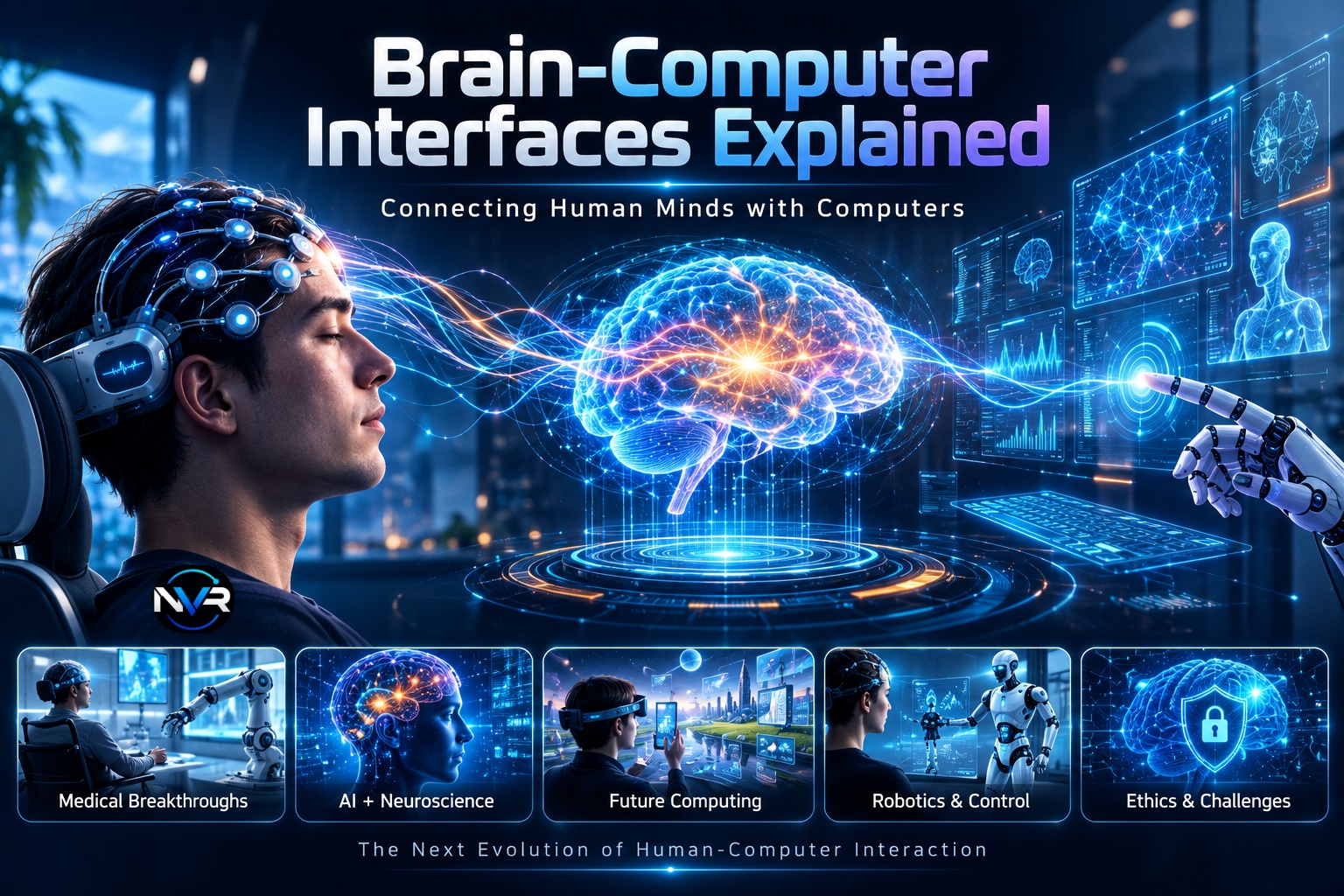
Brain-Computer Interfaces Explained
Brain-Computer Interfaces (BCIs) allow direct communication between the human brain and computers. Discover how this groundbreaking technology is transforming healthcare, communication, robotics, and the future of human-computer interaction.