How AI Is Changing Manufacturing
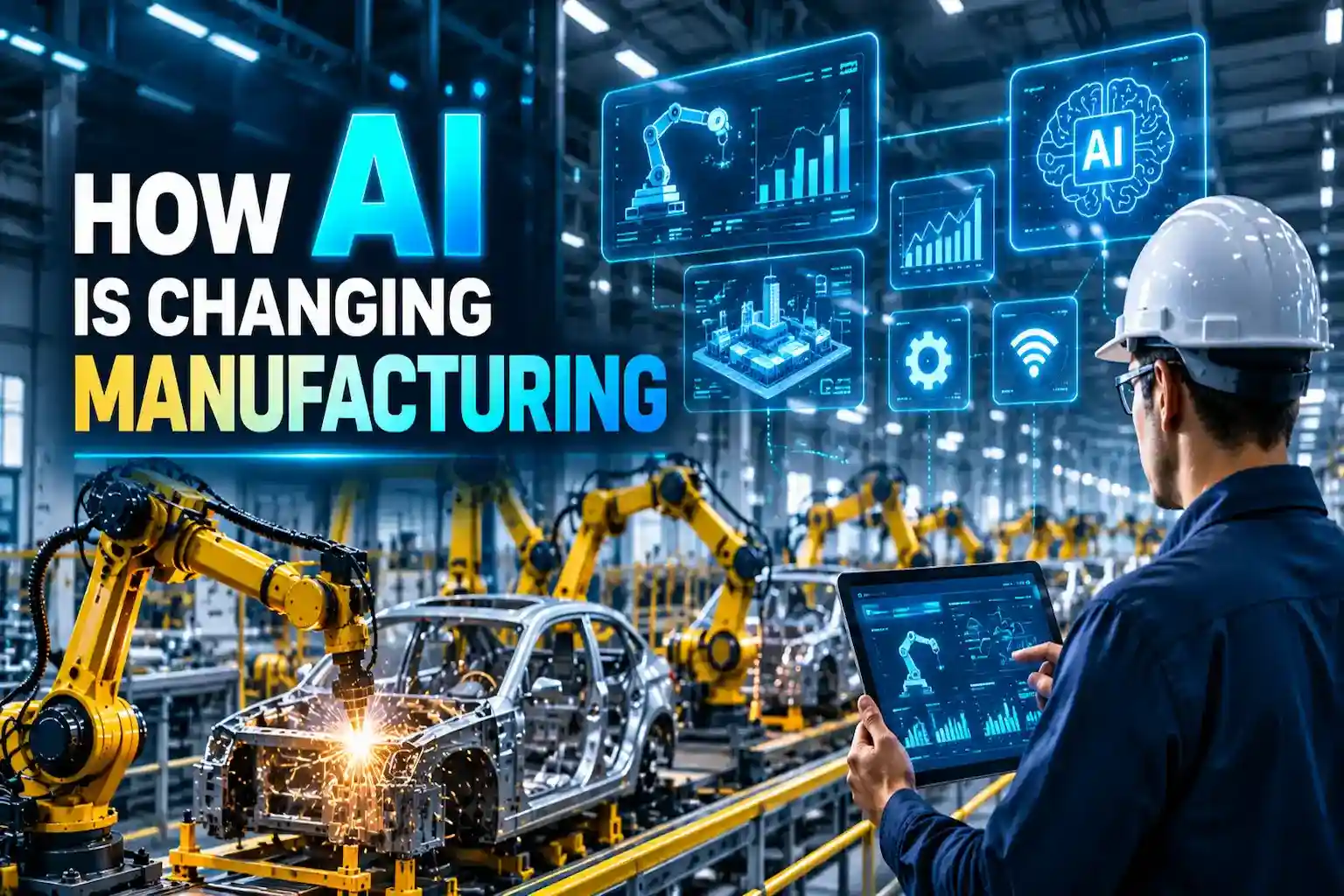
AI can help inspect parts, monitor equipment, and support production decisions. Explore how these applications work, why accuracy figures can mislead, and what factories need to check before connecting models to real processes.
Listen to this article
How AI Is Changing Manufacturing
13 parts · Tap play to start
Uses a natural English voice available through your browser or device. Article text is not uploaded to NVR Nexus.
Introduction
On a factory floor, AI is most useful when it solves a defined problem: flagging a suspicious surface mark, identifying a change in machine behavior, or helping a planner compare production options. These tasks require different data, validation, and operating limits.
A demonstration that recognizes a part is not proof that a complete production line will become more reliable. The result depends on the cameras, sensors, machinery, software, workers, and procedures around the model. An accurate prediction can still be useless if nobody can act on it in time.
This article explains practical applications and how to assess their claims. It is not a machinery operating procedure or a safety certification. Changes to equipment, controls, maintenance, and safeguarding require qualified assessment and the applicable site procedures, equipment instructions, and requirements.
AI Is One Component of Manufacturing Automation
Many automated processes follow programmed sequences without a learned model. A conveyor moving at a set speed or a robot repeating a fixed motion does not necessarily use AI. A model may add a specific capability, such as recognizing an unfamiliar orientation or estimating an equipment condition.
A useful distinction is between observation, recommendation, and control. Software can display an anomaly, suggest an inspection, or directly influence equipment. Each step gives the system more operational authority and changes what needs to be validated.
The 2026 smart-manufacturing roadmap listed by NIST covers applications including sensing, robotics, digital twins, and production-related optimization. It also identifies persistent challenges in industrial data, integration, and reliable operation. A roadmap describes research and deployment needs; it is not proof that every capability is mature or suitable for every factory.
Predictive Maintenance: An Alert Needs an Action Plan
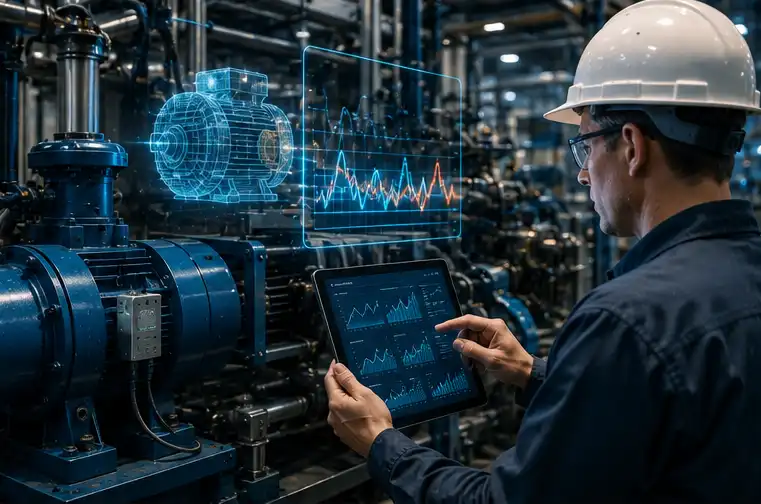
Condition monitoring observes equipment behavior; diagnosis investigates a fault; prognosis estimates how a condition may develop. Machine learning can support parts of this process, but detecting an unusual vibration is different from knowing exactly when a machine will fail.
NIST's monitoring, diagnostics, and prognostics research emphasizes measurement methods and the verification and validation of maintenance technologies. The objective is to support decisions about planned and unplanned downtime, not to assume that a prediction alone prevents a breakdown.
Consider an illustrative alert about a bearing. A useful workflow must establish whether the signal is trustworthy, who investigates it, and how any work is planned safely. Repeated false alarms can add inspection work, while missed faults can remain undetected. The conceptual image shows monitoring, not evidence of a particular machine's condition.
Quality Inspection: A Flag Is Not the Same as a Measurement
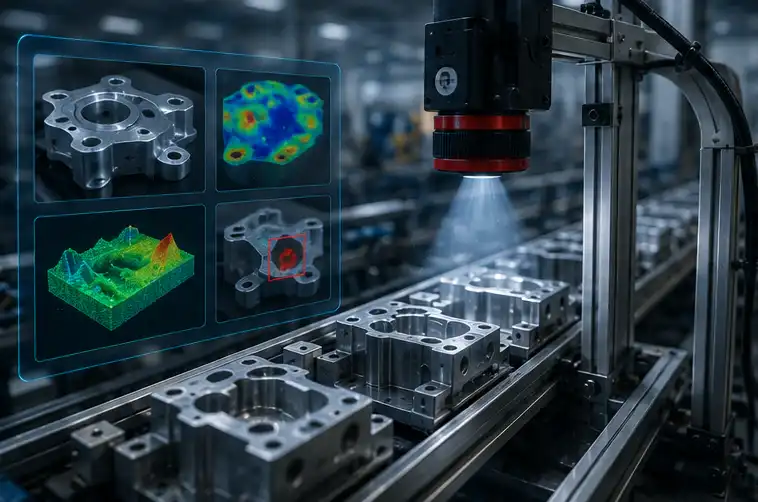
Computer vision can help locate or classify visible features such as a missing component or a surface mark. Its performance depends on what the imaging setup can see and what defects the system was developed to recognize. A normal-looking image does not establish that every physical requirement has been met.
NIST's Augmented Intelligence for Manufacturing Systems project combines measurement science, physics-based models, and AI. This is an important distinction: a learned pattern can complement established measurements without replacing the need to verify the actual property of interest.
The inspection image is illustrative, not a validated inspection method. A production team needs a defined acceptance criterion, trustworthy reference decisions, and a route for uncertain cases. A surface classifier should not silently become a substitute for a dimensional or internal-defect test it was never designed to perform.
Why 99% Accuracy Can Still Mean Missing Every Defect
Here is a simplified numerical example, not a reported factory result. Suppose a batch contains 1,000 parts: 990 acceptable parts and 10 defective ones. A system that labels every part acceptable gets 990 decisions right, so its overall accuracy is 99%. Yet it misses all 10 defects.
That is why a headline percentage is insufficient. Ask how many defective parts were missed, how many good parts were rejected, and what happened to uncertain cases. The cost of a false rejection can differ greatly from the consequence of releasing a defective product.
NIST MEP's implementation guide similarly warns about imbalanced data, false alarms, and evaluating industrial AI outside its operational context. Our recommendation is to assess the actual decision and its consequences, not select a model using one impressive average score.
Robotics: AI and the Cobot Label Do Not Establish Safety
AI can contribute perception or task planning within a robotic application. It does not make a moving robot, its tool, or the surrounding process inherently safe. A system recognizing an object is different from a validated safety function protecting a person.
OSHA's technical manual discusses application-specific hazard analysis, risk assessment, safeguarding, and worker training, including for collaborative applications. The relevant assessment concerns the complete task and system, not just the robot's product category. This is U.S. guidance; applicable requirements depend on the location and installation.
Changes to the tool, workpiece, layout, speed, or interaction with workers may change the hazards. Qualified people need to assess those changes and the appropriate controls. Do not use an AI output as a reason to bypass guards, interlocks, energy-isolation procedures, or other established safeguards.
Planning and Digital Twins: Useful Models Need Constraints
Possible planning applications include estimating demand, identifying likely bottlenecks, or comparing schedules. A digital twin represents aspects of a physical asset or process using models and data; it is not necessarily an AI system, and it is not a perfect copy of reality.
For an illustrative scheduling problem, a plan might reduce idle time on one machine while overlooking a downstream capacity limit, a cleaning requirement, or a shortage of qualified operators. The proposed schedule can be mathematically attractive yet operationally unusable.
Treat the model as a way to explore options under stated assumptions. Check which constraints and costs are included, how current the input data is, and whether the proposed changes are feasible. Improved forecasting or simulated throughput should not be presented as a guaranteed gain in actual production.
Data Changes, Integration Costs, and Worker Knowledge
Factory data has context. A higher temperature could reflect a fault, a different product, a heavier load, or a changed operating condition. Models need representative information and reliable labels, not simply a large quantity of readings.
An illustrative inspection system trained on one finish may behave differently after a supplier, camera, lighting arrangement, or material changes. Teams should record meaningful changes, review performance, and validate updates rather than assume that the model continually improves on its own.
Budget for the entire workflow: sensors, installation, data preparation, integration, validation, support, and correction work. Operators, quality specialists, maintenance staff, and engineers can explain exceptions that a dataset does not. Whether tasks or jobs change depends on deployment choices; claims that AI always replaces workers or never affects employment are both too broad.
Operational Technology Security and Controlled Permissions
Operational technology, or OT, monitors or controls physical processes. NIST's Guide to OT Security emphasizes that these systems have distinctive performance, reliability, and safety requirements. Connecting an AI service to production equipment is therefore different from using a chatbot to draft an office document.
Define what the service can read, recommend, and change. Assess dependencies such as remote access, supplier services, network connections, and model updates. A failure or unsuitable change can affect the wider process even if the model usually performs well.
As a practical governance check, decide who approves updates, who can disable the AI component, and what validated fallback is available. Keep confidential production information out of unapproved services. Generated maintenance instructions or code also require competent review before they influence real equipment.
A Practical Starting Point for a Manufacturing AI Pilot
Our suggested starting point is one bounded use case with measurable outcomes and accountable owners. This is a planning checklist, not authorization to alter a machine or a substitute for a site-specific engineering and safety review.
- Define the problem and baseline: for example, missed defects, avoidable inspection work, or a specific maintenance delay.
- Set operating limits and acceptance criteria, including false positives, missed events, response time, and consequences of an error.
- Evaluate on representative data kept separate from training, across relevant products, shifts, and conditions.
- Where appropriate, compare recommendations without allowing them to change production until the required reviews and approvals are complete.
- Measure the whole result: quality, throughput, unplanned stops, review effort, total cost, and the ability to recover safely.
- Assign responsibility for monitoring, updates, incident handling, and stopping or rolling back an unsuitable deployment.
Frequently Asked Questions
Conclusion
AI's role in manufacturing is best understood through specific decisions and operations, not a promise of a self-running factory. Useful systems connect reliable observations to validated actions while making errors, uncertainty, and responsibilities visible.
Our assessment is that a credible improvement should hold up across real operating conditions and include its integration, supervision, and recovery costs. Better predictions and faster analysis can help, but quality, safety, and practical factory knowledge remain essential parts of the system.
Reviewed against primary sources
References and further reading
These research reports and official guidance provide the evidence and practical recommendations used to review this article.
- 2026 Roadmap on Artificial Intelligence and Machine Learning for Smart ManufacturingNational Institute of Standards and Technology publication record (2026)
- Monitoring, Diagnostics and Prognostics for Manufacturing OperationsNational Institute of Standards and Technology
- Augmented Intelligence for Manufacturing Systems (AIMS)National Institute of Standards and Technology
- Artificial Intelligence: Key Consideration and Effective Implementation StrategiesNIST Manufacturing Extension Partnership
- Industrial Robot Systems and Industrial Robot System SafetyOccupational Safety and Health Administration Technical Manual
- Guide to Operational Technology (OT) Security, SP 800-82 Revision 3National Institute of Standards and Technology (2023)
Knowledge Hub
Learn the fundamentals first
Plain-language explainers to help you understand the concepts behind this article.
Share this article
Keep reading
Related Articles
More stories on similar topics from the NVR Nexus blog.

How AI Is Changing Media and Journalism
Artificial intelligence is changing how newsrooms research stories, analyze evidence, create formats, reach audiences, and verify digital media. The opportunity is significant—but so are the risks to accuracy, transparency, trust, and editorial independence.
How AI Is Changing the Legal Industry
Artificial Intelligence is transforming the legal industry through contract analysis, legal research, document automation, compliance monitoring, and predictive case insights. Discover how AI is reshaping the future of legal services.
How AI Is Changing Sports
Artificial Intelligence is transforming sports through performance analytics, injury prevention, intelligent coaching, AI referees, fan engagement, and data-driven decision making. Discover how AI is reshaping the future of sports.